
Is one of the biggest risks in pensions drawdown well understood? We take a closer look and consider a simple way to reduce it.
Most people aren’t aware of what may be the biggest investment risk in retirement if you use pensions drawdown. For many it may pose a far greater risk than choosing between funds in the same asset class.
It is an elephant in the room that people don’t seem to understand well. The elephant has a techy name. Its called “Sequencing risk”. Sounds techy, but it is really quite a simple concept around timing of asset sales.
Once you need to take money from your pension pots, most people need to sell assets within these pots. When you sell those assets to make the payments, you know their final value. What you get is what you get! Those assets have no further chance to recover.
If you need to sell assets when their value is down, that can lead to a bad overall outcome. If you can sell assets when values are up, that is much preferable.
Different assets values move in different ways
Investors expect some assets, such as shares in global stock markets, to grow over time as the global economy grows. However, these assets can move up and down a lot in shorter periods when investors’ views on future growth change. Investors describe these movements as “volatility”.
Other assets (cash being the easiest example to think about) have no real volatility. The actual value does not rise or fall. The interest paid may vary, but the value stays the same.
These represent two ends of the spectrum. Shares reliant on growth can be very volatile, cash has a fixed value.
There are other assets in between. These can include some short-term bonds and shares that pay larger incomes. The future income expected from them has value. Given this, their value may be less volatile than those shares that rely mainly on future growth prospects.
The timing (sequence) of sales matters (a lot)!
By building a plan with us, you know when you would like to retire. You also have a good idea of the payments you need to take from your pension pots each year. These amounts can also include any tax-free cash lump sum at retirement, if wanted. You can count this as just another large payment in year one. Pensions drawdown is needed to meet these payments.
Here is an example below ignoring any tax free cash. In the Design page, you can see the payments needed from your pension pots. These payments sit alongside the expected payments from everything else in your plan.
Next to it, we have then taken away everything else. You can then see the annual cashflows expected from your pension pots more clearly when shown on their own.

In those first five years, the payments needed from the pension pots are quite large. In this plan, the person will need to sell assets from these pots soon after retirement. If they have to sell at a bad time, real problems can arise, which are difficult to recover from.
One option to reduce this risk is to keep enough in non volatile assets. This can provide a buffer for the expected payments.
Let’s take cash in a Money Fund as the easiest example for the buffer. Any remaining monies go into a Growth Fund in this example.
The chart below is the same as the one above. This is a chart we plan to add to the site, with the added ability to consider investment choices in terms of future payments needed.
In this example, allocating funds to a Money Fund creates the buffer of expected payments. As we know the expected payments in the plan, we can calculate how many years the Money Fund provides a buffer for. We can then show this to our users. In this example, as you can see, it covers the expected payments for the first 5 years.
If the payments needed are as expected, there is no need to sell any other types of assets over this period. The value of the Money Fund alone can cover the payments. Over time, the retiree may move more assets to the Money Fund to replace those used for payments. This keeps the buffer rolling over time if they want to. They can see this buffer update whenever they want depending on what is left in the Money Fund.
However the key point in this example is this.
- They have a 5 year window where they don’t need to sell Growth assets.
- They also have that period to choose an opportune time to move any more money to the Money Fund to keep the buffer going if wanted.
We would like to understand if our users understand the concept above and if we show it clearly. We want to check before adding the chart and wording below to the site.
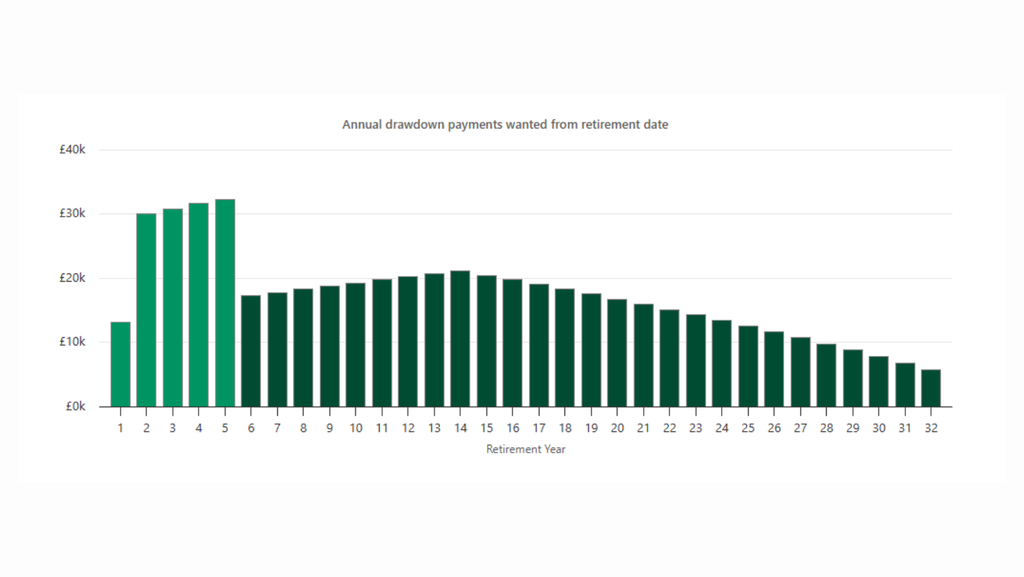
The allocation to different funds will be input by the user and modeled and described as below in italics.
The chart currently shows 27 years of payments in dark green. These payments rely on you achieving returns on all your Funds or selling assets from the Growth Fund. Therefore, you face much more risk that you can’t meet these payments if returns fall short of expectations or you need to sell Growth Fund assets after market values fall.
There are currently 5 years of payments shown in a lighter green colour. These expected payments can be met solely from the estimated funds in the Money Fund at retirement.
It is key to understand your reliance on positive returns and more risky growth funds as downturns can occur at any time.
As you change the allocations above, the expected chart payments may change to a lighter colour. If they do, this shows that the expected value in the Money fund at Retirement alone could meet these payments. The more money in this fund, the more payments change colour.
The fewer that change colour, the higher the risk that future payments may not be met. These payments rely on Growth funds and overall future investment returns. There is more risk if payments in the early years after retirement do not change colour. With pensions drawdown, selling funds after they have fallen in value near the start of retirement can be very difficult to recover from.
Quick survey
We would be really grateful if you let us know if the wording and charts above provide you with a good understanding of the issues discussed.
Any added feedback, suggestions or questions you may have. Just email us at contact@guiide.co.uk.
Disclaimer
This post is solely for information . However if we introduce this modeling it may lead users to chose products or advice from our site. To be completely clear Guiide has commercial relationships with entities on our site. That is how we can provide our site for free to everyone. They may license a version of our model, or pay us a referral fee if you choose their services or products. This does not affect any cost of advice, or price of any product provided to you.
Many other product providers and advisers are available and you can visit Moneyhelper if you need help on this.
Remember when investing your capital is at risk
Information and calculations provided by this website are intended as guidance only to assist your retirement planning and does not in any way constitute financial advice in any form. Bespoke Retirements Ltd trading as Guiide (Company number SC463898) is authorised and regulated by the Financial Conduct Authority. Firm Reference Number (FRN) is 1031526.